
Therapy, Counseling, and Psychiatry: Understanding the Differences

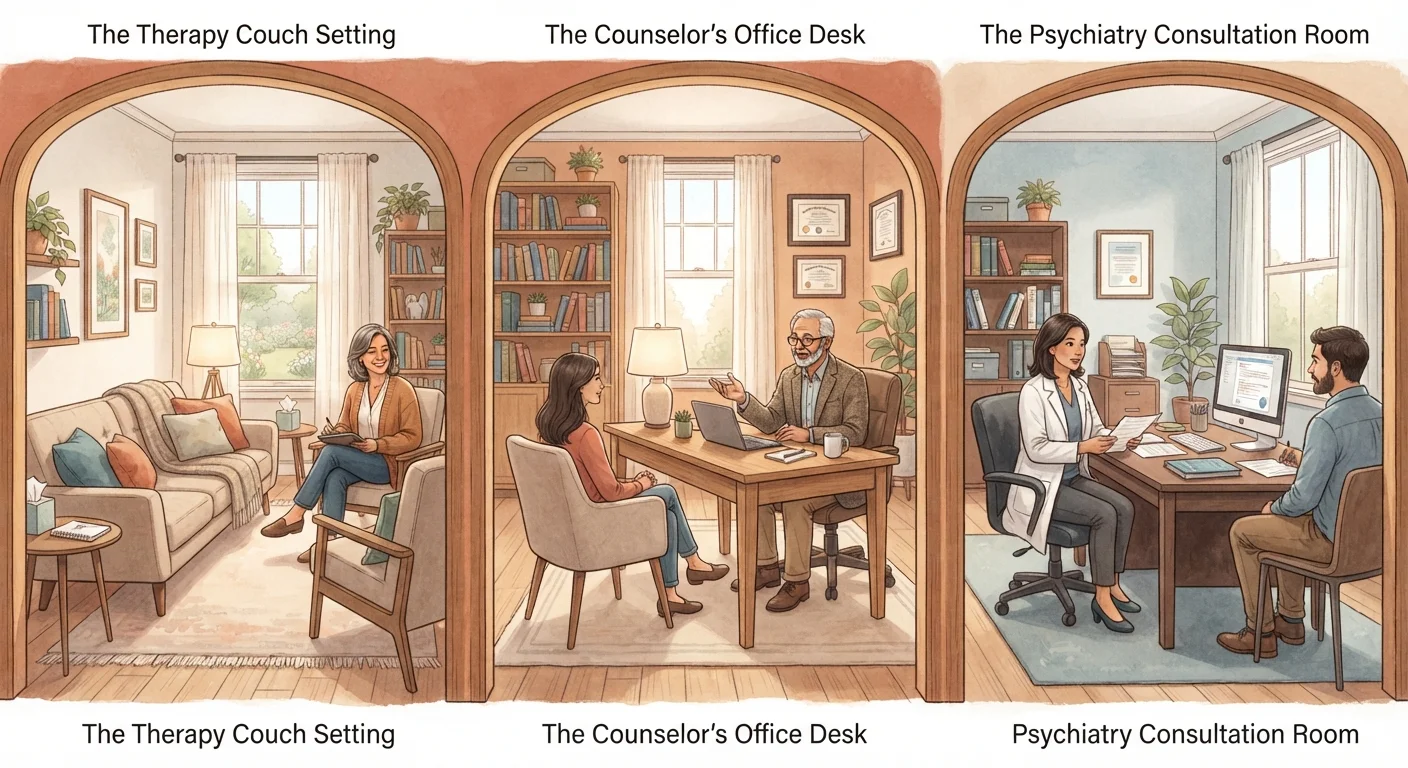
Photo: ScoutAnswers.com | Blogs That Ignite Curiosity editorial
Why the Terminology Matters
When someone decides to seek mental health support, one of the first hurdles is figuring out who to see. Therapist? Counselor? Psychiatrist? Psychologist? The terms get used interchangeably in everyday conversation, but they refer to meaningfully different roles with different training, scopes of practice, and approaches to care.
Understanding these distinctions isn't just trivia - it helps people find the right kind of support faster and set realistic expectations about what that support looks like. It also helps normalize the entire landscape of mental health care, which is something worth actively doing. As explored in our piece on what mental wellness actually means, the concepts we use to talk about mental health shape how we think about it and whether we seek help at all.
| Therapist | Licensed mental health professional providing talk-based treatment (LCSW, LPC, LMFT, psychologist) |
| Counselor | Focuses on specific challenges and life transitions; scope varies by specialty and licensure |
| Psychiatrist | Medical doctor (M.D./D.O.) who can diagnose, prescribe medication, and manage psychiatric conditions |
| Psychologist | Doctoral-level (Ph.D./Psy.D.) specialist in assessment and psychotherapy; prescribing rights vary by state |
| Split Treatment Model | Combining psychiatrist (medication) and therapist (talk therapy) for coordinated care |
| Common First Entry Point | Primary care physician, who can refer to the appropriate specialist |
Therapists and Psychologists: Talk-Based Treatment
The word therapist is an umbrella term. It typically refers to a licensed mental health professional - such as a Licensed Clinical Social Worker (LCSW), Licensed Professional Counselor (LPC), Licensed Marriage and Family Therapist (LMFT), or a psychologist - who provides structured, talk-based treatment for emotional and behavioral concerns.
Psychologists (often holding a doctoral degree, Ph.D. or Psy.D.) specialize in psychological assessment and psychotherapy. In most U.S. states, psychologists cannot prescribe medication, though a small number of states have granted limited prescribing authority to specifically trained psychologists.
Therapists use evidence-based approaches such as Cognitive Behavioral Therapy (CBT), Dialectical Behavior Therapy (DBT), or trauma-focused therapies to help people understand thought patterns, develop coping strategies, and work through distressing experiences. Sessions are typically ongoing and may span weeks, months, or longer depending on the person's goals and circumstances.
Psychotherapy
A structured, evidence-based form of treatment involving conversation between a trained clinician and a client. It aims to address emotional difficulties, behavioral patterns, and mental health conditions through techniques such as CBT or DBT.
Cognitive Behavioral Therapy (CBT)
One of the most widely researched psychotherapy approaches, CBT focuses on identifying and changing unhelpful thought patterns and behaviors. It is used for conditions including depression, anxiety, and PTSD.
Psychiatric Medication Management
The ongoing process by which a psychiatrist evaluates, prescribes, and adjusts medications used to treat mental health conditions. This may involve monitoring for effectiveness and side effects over time.
Licensure
A state-issued credential that authorizes a mental health professional to practice within a defined scope. Requirements vary by state and credential type (e.g., LCSW, LPC, LMFT).
Scope of Practice
The range of services, assessments, and treatments a professional is legally and professionally authorized to provide based on their training and licensure.
Counselors: Guidance for Life's Challenges
Counselors often focus on specific, present-oriented challenges rather than deep-rooted psychological treatment - though the line between counseling and therapy isn't always sharp. School counselors, career counselors, substance use counselors, and grief counselors are all examples of professionals who help people navigate defined situations and transitions.
Many licensed counselors (such as LPCs or Licensed Mental Health Counselors, LMHCs) are also trained to provide therapy and may work with anxiety, depression, relationship difficulties, and life adjustments. Their work tends to emphasize practical skills and short-to-medium-term support, though this varies considerably by specialty and setting.
If you're uncertain whether a counselor's scope of practice fits your needs, it's reasonable to ask them directly about their training and what they typically treat. Counselors themselves are often the best resource for knowing when a referral to another type of provider makes sense. For more on dismantling the stigma around seeking any of these supports, see our article on common mental health myths.
Psychiatrists: Medical Expertise and Medication Management
A psychiatrist is a medical doctor (M.D. or D.O.) who completed medical school and a residency in psychiatry. This medical background is the defining difference: psychiatrists can diagnose mental health conditions, prescribe and manage psychiatric medications, and evaluate whether symptoms have underlying medical causes.
Many psychiatrists today focus primarily on medication evaluation and management rather than ongoing talk therapy, though some do provide both. For conditions such as schizophrenia, bipolar disorder, or treatment-resistant depression - where medication is often a central component of care - a psychiatrist's involvement is typically essential.
A common and effective arrangement in mental health care is what's sometimes called a split treatment model: a person sees a psychiatrist for medication management while also working with a therapist or counselor for ongoing talk-based support. These roles complement each other rather than compete.
When to Consider a Psychiatrist
This article is for general informational purposes only and is not a substitute for professional medical or mental health advice. If you have concerns about your mental health, please consult a qualified healthcare professional.
Choosing a Starting Point
There's no single correct entry point into mental health care. A primary care physician can be a helpful first stop - they can rule out physical causes for symptoms, provide referrals, and in some cases prescribe psychiatric medication for common conditions. Many people also start directly with a therapist or counselor, particularly if their concerns center on stress, relationships, grief, or anxiety.
If you're unsure where to begin, talking to someone you trust can be a genuinely practical first step - not as a replacement for professional support, but as a way to get clarity on what you're experiencing and what kind of help might fit.
Insurance coverage, cost, availability, and personal comfort all play real roles in the decision. Understanding the differences between provider types helps ensure that when you do find someone, you're positioned to make the most of that relationship.
The content on this site is for informational purposes only and is not a substitute for professional advice. Always consult a qualified professional for guidance specific to your situation.