
Fixed-Rate vs. Adjustable-Rate Mortgages: Understanding the Trade-Offs

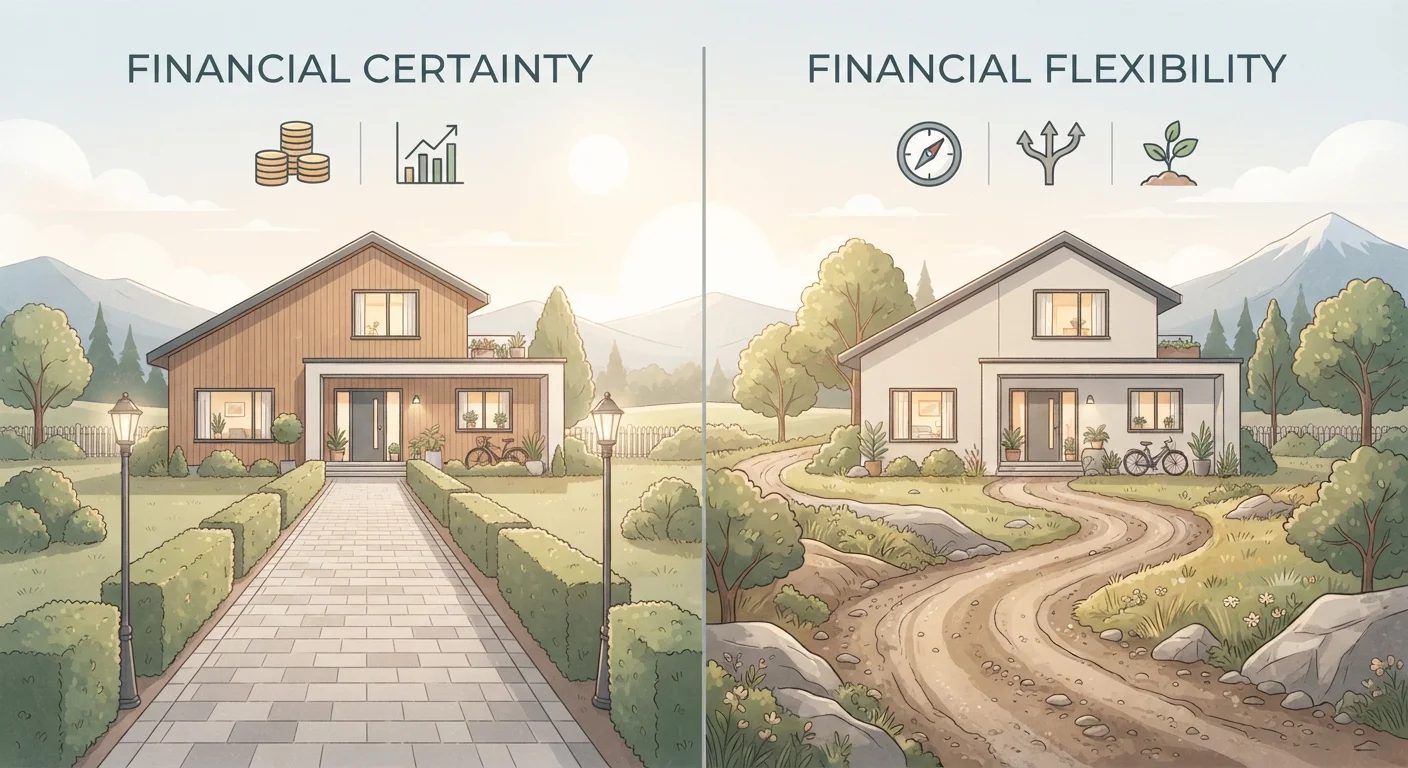
Photo: ScoutAnswers.com | Blogs That Ignite Curiosity editorial
Key Takeaways
- Fixed-rate mortgages lock in your interest rate for the entire loan term, eliminating payment uncertainty.
- ARMs offer a lower introductory rate that adjusts periodically based on a market benchmark index.
- The right choice depends heavily on how long you plan to stay in the home.
- Rate caps on ARMs limit how much your rate can increase, but they don't eliminate risk.
- Refinancing is always an option, but it comes with costs and is never guaranteed to be available.
How Each Mortgage Type Is Structured
A fixed-rate mortgage carries the same interest rate for the entire life of the loan - typically 15 or 30 years. Your principal and interest payment never changes, which makes household budgeting straightforward. The rate you lock in at closing is the rate you pay on your final statement.
An adjustable-rate mortgage (ARM) works in two phases. The first phase is a fixed introductory period - commonly expressed as 5/1, 7/1, or 10/1 - during which the rate stays constant. After that initial window closes, the rate adjusts periodically (usually once per year) based on a benchmark index, such as the Secured Overnight Financing Rate (SOFR), plus a lender margin. Because of the lower introductory rate, ARMs often allow buyers to qualify for a larger loan amount or reduce early payment costs.
For a broader look at how market forces shape both types of loans, see how Federal Reserve decisions ripple through to mortgage rates.
| Criterion | Fixed-Rate Mortgage | Adjustable-Rate Mortgage (ARM) |
|---|---|---|
| Interest Rate | Locked for entire loan term | Fixed initially, then adjusts periodically |
| Initial Monthly Payment | Typically higher | Typically lower |
| Payment Predictability | Fully predictable | Varies after introductory period |
| Rate Risk | None after closing | Rate can rise based on index |
| Rate Cap Protections | Not applicable | Per-adjustment and lifetime caps apply |
| Best Loan Term Length | 15 or 30 years | 5/1, 7/1, or 10/1 common structures |
| Ideal Hold Period | Long-term (10+ years) | Short-to-medium term (under 7 years) |
| Refinancing Incentive | Only if market rates drop | Often planned before first adjustment |
Rate Caps, Risk, and What Can Actually Change
One of the most common misconceptions about ARMs is that they're entirely unpredictable. In practice, lenders are required to disclose rate caps - limits on how much the rate can rise at any single adjustment and over the life of the loan. A typical cap structure might be expressed as 2/2/5: the rate can increase no more than 2% at the first adjustment, 2% at each subsequent adjustment, and 5% total above the initial rate.
That said, caps protect against extreme spikes - they don't guarantee your payment will stay affordable. A borrower who starts at a 6% introductory rate could face a rate as high as 11% at the worst-case ceiling. Running the numbers on that scenario before signing is essential.
~70%
Share of mortgages that are fixed-rate
Fixed-rate loans have consistently dominated US mortgage originations, according to data from the Federal Reserve Bank of St. Louis and mortgage industry surveys.
1-2%
Typical ARM initial rate discount vs. fixed
ARM introductory rates are generally 1-2 percentage points lower than comparable fixed-rate loans at origination, though the gap varies with market conditions.
5/1
Most common ARM structure in the US
The 5/1 ARM - fixed for five years, then adjusting annually - is among the most widely used adjustable structures, per Freddie Mac and lender origination data.
Fixed-rate loans carry no such adjustment risk. However, they do come with a different trade-off: if market rates fall significantly after you close, you'll pay above-market rates until you refinance - which involves closing costs and is not always possible depending on your financial situation at the time.
Understanding how fixed and variable costs interact in your overall household finances can sharpen your decision. Our mortgage and market resource hub covers these dynamics in depth.
When the Math Favors One Over the Other
The break-even point is central to this decision. If you plan to stay in the home long enough that the ARM's rate adjustments would cost more in cumulative interest than the fixed rate would have, the fixed loan is likely the better financial choice. If you expect to sell or refinance before significant adjustments kick in, the ARM's lower introductory rate may produce meaningful savings.
Prepaid mortgage points can shift this math further. Paying points upfront to reduce a fixed rate may make long-term ownership significantly cheaper - but only if you stay long enough to recoup the cost. When paying upfront saves money and when it doesn't walks through that calculation in detail.
There is also a less-discussed scenario: a high-rate environment where borrowers choose an ARM expecting rates to decline, planning to refinance into a fixed loan. This strategy can work, but it carries real risk - refinancing requires qualifying all over again, and rates don't always move in the expected direction.
This article is for general informational purposes only and does not constitute personalized financial or mortgage advice. Readers should consult a licensed mortgage professional or financial adviser to evaluate options based on their individual circumstances.
The content on this site is for informational purposes only and is not a substitute for professional advice. Always consult a qualified professional for guidance specific to your situation.