
What the Federal Funds Rate Actually Does to Your Mortgage

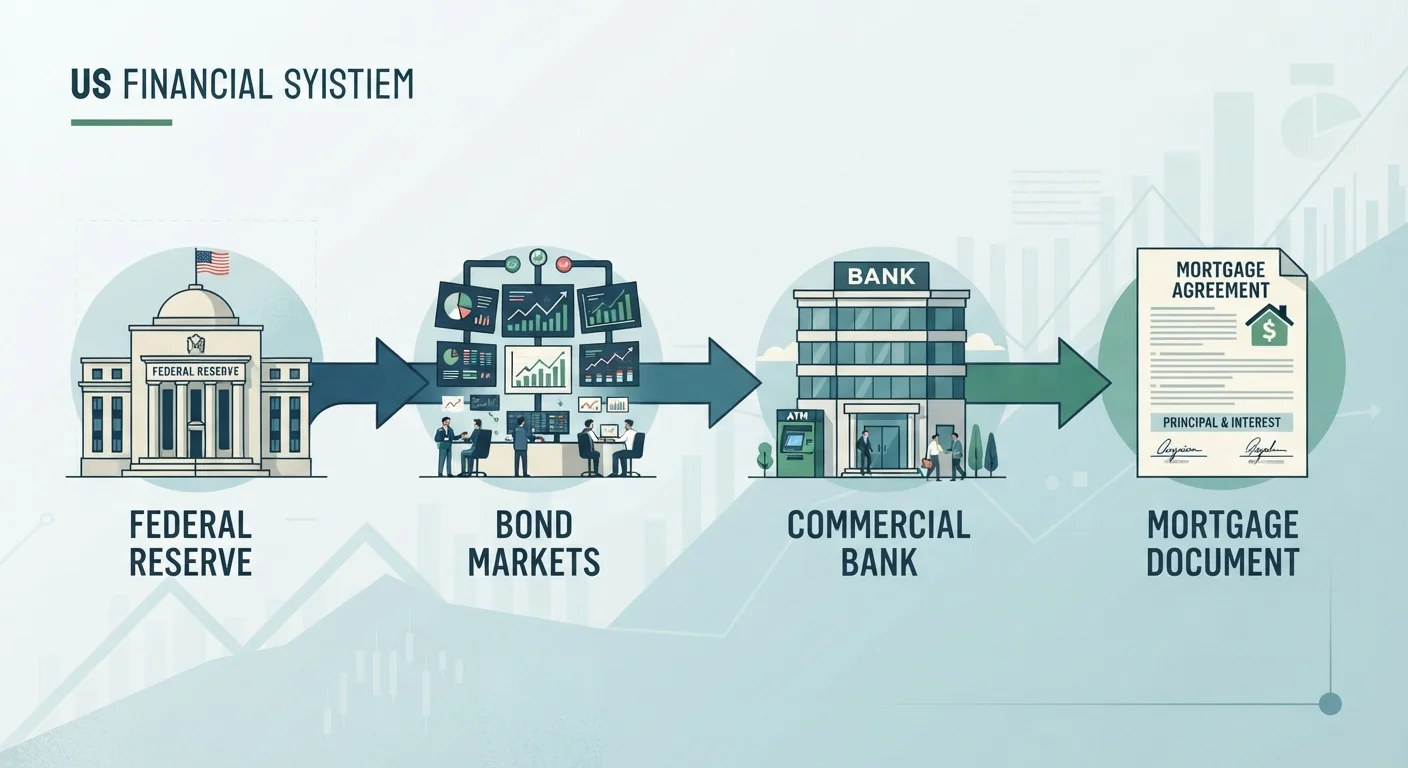
Photo: ScoutAnswers.com | Blogs That Ignite Curiosity editorial
Key Takeaways
- The Fed does not set mortgage rates - it sets the rate banks charge each other for overnight loans.
- Mortgage rates are more directly tied to the 10-year U.S. Treasury yield than to the federal funds rate.
- Fixed-rate and adjustable-rate mortgages respond differently to Fed policy changes.
- When the Fed raises rates to fight inflation, mortgage rates typically rise - but the relationship isn't one-to-one.
- Understanding this relationship helps borrowers make more informed timing and loan-type decisions.
The Fed's Role: What It Actually Controls
When the Federal Reserve raises or cuts rates, headlines immediately speculate about mortgage costs - but the connection is more indirect than most coverage suggests. The Fed sets the federal funds rate, which governs what banks charge each other for short-term, overnight loans. This rate anchors short-term borrowing costs across the economy, from credit cards to auto loans to home equity lines of credit.
Mortgage rates, particularly the widely used 30-year fixed rate, are a different animal. They're primarily determined by the yield on 10-year U.S. Treasury bonds and the market for mortgage-backed securities (MBS) - pools of home loans bought and sold by investors. When investors demand higher returns to hold these assets, lenders must offer higher rates to attract capital, which flows directly into what borrowers pay.
That said, the federal funds rate shapes the broader climate in which all of this happens. When the Fed tightens policy to cool inflation, investors tend to demand higher yields across the board, including on Treasuries and MBS. The result is upward pressure on mortgage rates - even if there's no direct mechanical link.
~0.50-0.75%
Typical spread between 10-year Treasury yield and 30-year fixed mortgage rate
Historically, 30-year fixed mortgage rates have tracked roughly 1.5-2 percentage points above the 10-year Treasury yield, though this spread widens during periods of market stress.
8 per year
Federal Open Market Committee meetings annually
The FOMC meets approximately eight times per year to assess economic conditions and vote on any changes to the federal funds rate target range.
Fixed vs. Adjustable: Two Very Different Relationships
Not all mortgage types respond to Fed policy in the same way, and this distinction matters when choosing a loan.
Fixed-rate mortgages are priced off long-term market expectations. A 30-year fixed rate reflects where investors think inflation and growth will land over the coming decades - not just what the Fed is doing today. This is why fixed rates can actually fall during a period of Fed rate hikes, if markets believe the tightening will eventually slow the economy and bring inflation down.
Adjustable-rate mortgages (ARMs) are much more directly connected to the Fed. Most modern ARMs are tied to the Secured Overnight Financing Rate (SOFR), which closely tracks the federal funds rate. When the Fed raises rates, the index your ARM references tends to follow - meaning your monthly payment can rise at each adjustment period. See our side-by-side breakdown of fixed and adjustable mortgages for a deeper look at how these structures differ in practice.
Watch the 10-Year Treasury, Not Just Fed News
Other Factors Lenders Weigh Beyond the Fed
Even if you understand the Fed's influence, the rate you're quoted is shaped by additional layers of lender and borrower-specific variables.
- Your credit profile: Lenders price risk. Borrowers with stronger credit scores typically receive meaningfully lower rates. Learn more about how your credit score shapes your mortgage options.
- Loan-to-value ratio: A larger down payment reduces lender risk and often results in a better rate.
- Loan type and term: A 15-year fixed carries a lower rate than a 30-year fixed. Government-backed loans (FHA, VA) are priced differently than conventional products.
- Discount points: Borrowers can pay upfront to reduce their rate permanently. Whether this makes financial sense depends on how long you plan to stay in the home - a question explored in detail in our guide to mortgage discount points.
The Fed's decisions set the macroeconomic backdrop, but these individual factors ultimately determine the number on your loan offer.
What This Means for Buyers and Homeowners
For prospective buyers, understanding the Fed-mortgage relationship helps set realistic expectations. When the Fed is in a rate-hiking cycle, the mortgage market often tightens before each formal announcement as investors reprice risk. Waiting for a specific Fed meeting to lock a rate can mean paying a premium that was already built in weeks earlier.
For existing homeowners, a fixed-rate loan insulates you from Fed action entirely - your rate is locked regardless of what happens at future FOMC meetings. Homeowners with ARMs, however, should monitor their adjustment caps and understand when their next reset occurs relative to the rate environment. If your ARM is approaching an adjustment period in a high-rate environment, refinancing into a fixed-rate loan may be worth evaluating - though the math depends heavily on your remaining loan term, current rate, and closing costs.
The most useful takeaway: the Fed is a signal, not a switch. Its decisions reveal where monetary policy is headed, which gives borrowers context for the rate environment - but individual loan decisions should account for personal financial conditions, not just central bank headlines.
This article is for general informational and educational purposes only and does not constitute personalized financial, investment, or mortgage advice. Consult a licensed mortgage professional or financial adviser before making decisions about your home loan.
Frequently Asked Questions
The content on this site is for informational purposes only and is not a substitute for professional advice. Always consult a qualified professional for guidance specific to your situation.