
Fixed-Rate vs. Adjustable-Rate Mortgages: A Side-by-Side Breakdown

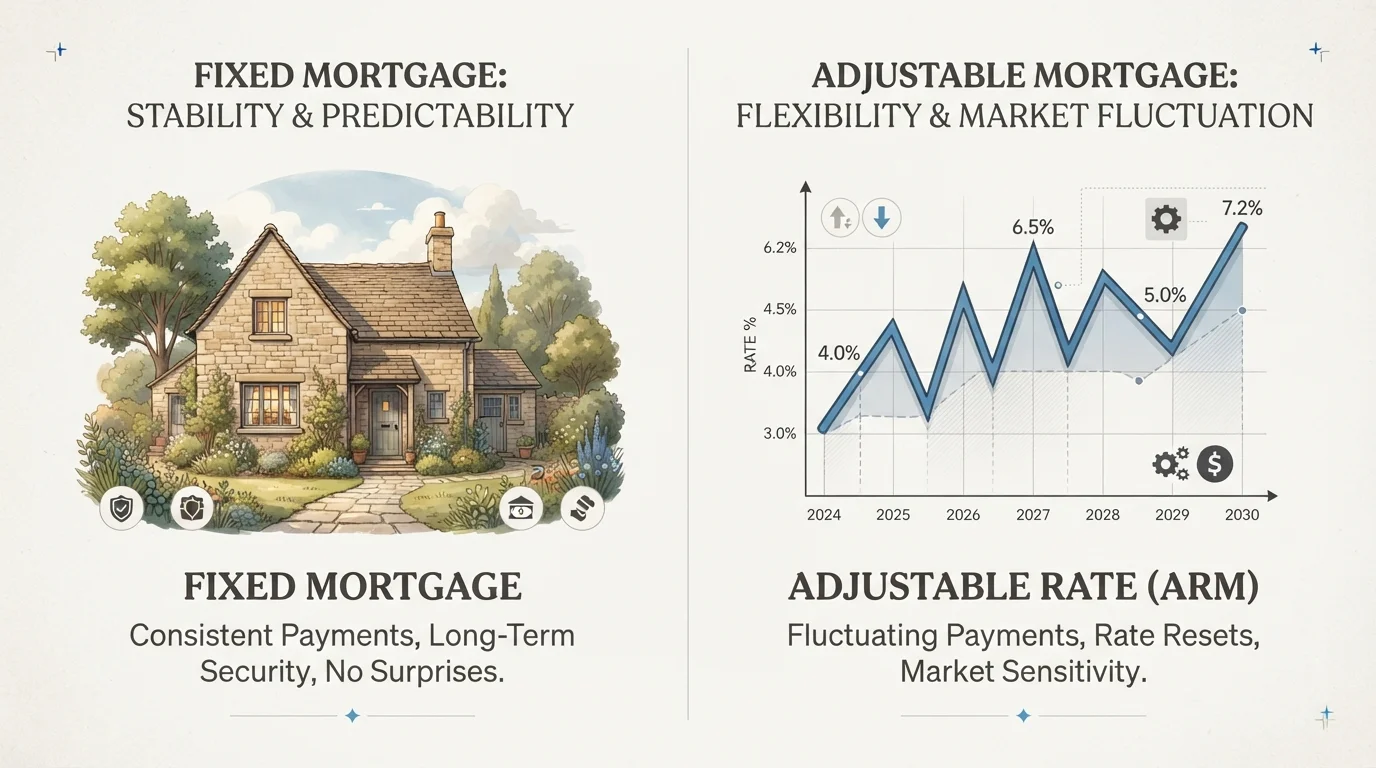
Photo: ScoutAnswers.com | Blogs That Ignite Curiosity editorial
Key Takeaways
- Fixed-rate mortgages lock your interest rate for the life of the loan, providing payment certainty.
- Adjustable-rate mortgages (ARMs) start with a fixed introductory period, then reset periodically based on a market index.
- ARMs often carry lower initial rates than fixed loans, but introduce payment uncertainty after the introductory period.
- Rate caps on ARMs limit how much your interest rate can rise per adjustment and over the loan's lifetime.
- Your expected time in the home and risk tolerance are the two most important factors in choosing between loan types.
- Refinancing can convert one loan type to the other, but timing and break-even costs matter significantly.
How Each Loan Type Is Structured
A fixed-rate mortgage carries the same interest rate from the first payment to the last. Whether your term is 15, 20, or 30 years, the rate set at closing never changes. That means your principal and interest payment is identical in month one and month 360 - a feature that simplifies long-term budgeting considerably. For a broader look at how fixed costs behave differently from variable ones, see our article on fixed vs. variable expenses.
An adjustable-rate mortgage (ARM) has two distinct phases. The initial fixed period - commonly 3, 5, 7, or 10 years - carries a set interest rate that is typically lower than comparable fixed-rate products. After that period ends, the rate resets periodically (often annually) based on a benchmark index, such as the Secured Overnight Financing Rate (SOFR), plus a lender margin. ARM products are usually described with two numbers: a 5/1 ARM, for example, has a five-year fixed period followed by annual adjustments.
| Criterion | Fixed-Rate Mortgage | Adjustable-Rate Mortgage (ARM) |
|---|---|---|
| Interest Rate | Locked for full loan term | Fixed initially, then adjusts periodically |
| Initial Rate Level | Typically higher at origination | Typically lower during intro period |
| Payment Predictability | Fully predictable, never changes | Variable after introductory period |
| Rate Caps | Not applicable | Initial, periodic, and lifetime caps apply |
| Best Ownership Timeline | Long-term (10+ years) | Short-to-medium term (3-7 years) |
| Market Risk Exposure | None after closing | Exposed to index rate movements |
| Common Terms Available | 15, 20, 30 years | 3/1, 5/1, 7/1, 10/1 ARMs |
| Refinancing Flexibility | Can refinance to ARM or lower fixed rate | Often refinanced to fixed before first reset |
Understanding how these structures interact with broader market conditions is important. The Federal Reserve's policy decisions influence the indexes that ARM rates are tied to, meaning macroeconomic shifts can directly affect your monthly payment after the introductory period ends.
Rate Caps, Risk, and Long-Term Cost
One of the most misunderstood aspects of ARMs is the cap structure that limits how much the rate can move. Most ARM products include three layers of protection:
- Initial cap: Limits how much the rate can change at the first adjustment (commonly 2% above the introductory rate).
- Periodic cap: Limits increases at each subsequent adjustment (typically 1-2%).
- Lifetime cap: Sets the absolute maximum rate over the life of the loan (often 5-6 percentage points above the starting rate).
These caps matter enormously in worst-case planning. A borrower who takes a 5/1 ARM at 6% with a 5% lifetime cap could eventually pay as much as 11% - a scenario that would materially increase monthly payments. Fixed-rate borrowers face none of this uncertainty.
~90%
Share of US mortgages that are fixed-rate
According to the Urban Institute's Housing Finance at a Glance, fixed-rate mortgages have historically dominated US originations, particularly during periods of rate uncertainty.
5-6%
Typical ARM lifetime rate cap above start rate
Most conforming ARM products in the US include a lifetime cap of 5 to 6 percentage points above the initial rate, as governed by standard loan guidelines.
~1-1.5%
Average initial rate discount on 5/1 ARMs vs. 30-year fixed
Freddie Mac's Primary Mortgage Market Survey has historically shown ARM introductory rates running roughly 1 to 1.5 percentage points below comparable fixed-rate products, though spreads vary with market conditions.
That said, ARMs are not inherently reckless. For buyers with a defined exit timeline - selling before the first adjustment, for instance - the lower introductory rate can reduce total interest paid. The key variable is how long you actually hold the loan. For a comprehensive overview of loan categories and qualification factors, see everything US homebuyers need to know about mortgage types.
Choosing Based on Your Timeline and Risk Tolerance
No single mortgage structure is universally superior - the right choice depends on your financial situation, ownership timeline, and comfort with payment variability. Consider these practical factors:
- How long will you stay? If you plan to own for fewer than seven years, an ARM's introductory savings may outweigh the risk of hitting adjustments. If you expect to stay 15 or more years, a fixed rate eliminates the uncertainty of multiple rate resets.
- How stable is your income? Fixed payments pair well with predictable incomes. If your earnings are likely to grow, an ARM's variable payments may be easier to absorb in later years.
- What is your refinancing plan? Some borrowers take an ARM with the intention of refinancing before the first adjustment. This strategy depends on future credit conditions and rate environments - neither of which is guaranteed. Our guide on refinancing your mortgage covers what to expect from that process.
- Have you explored rate buy-downs? Paying mortgage points upfront can lower a fixed rate meaningfully, sometimes shifting the economic case in favor of locking in. See when mortgage points save money to run that analysis.
Before committing to either structure, use the homebuyer's readiness checklist to confirm your finances, documents, and timeline are aligned. A licensed mortgage professional can model both options against your specific loan amount and local market conditions - general information like this article is educational and not a substitute for personalized advice.
This article is for general informational and educational purposes only. It does not constitute financial, mortgage, or legal advice. Mortgage products, rates, and terms vary by lender and individual circumstances. Consult a licensed mortgage professional before making any borrowing decision.
The content on this site is for informational purposes only and is not a substitute for professional advice. Always consult a qualified professional for guidance specific to your situation.