
Managing Credit Across Major Life Changes

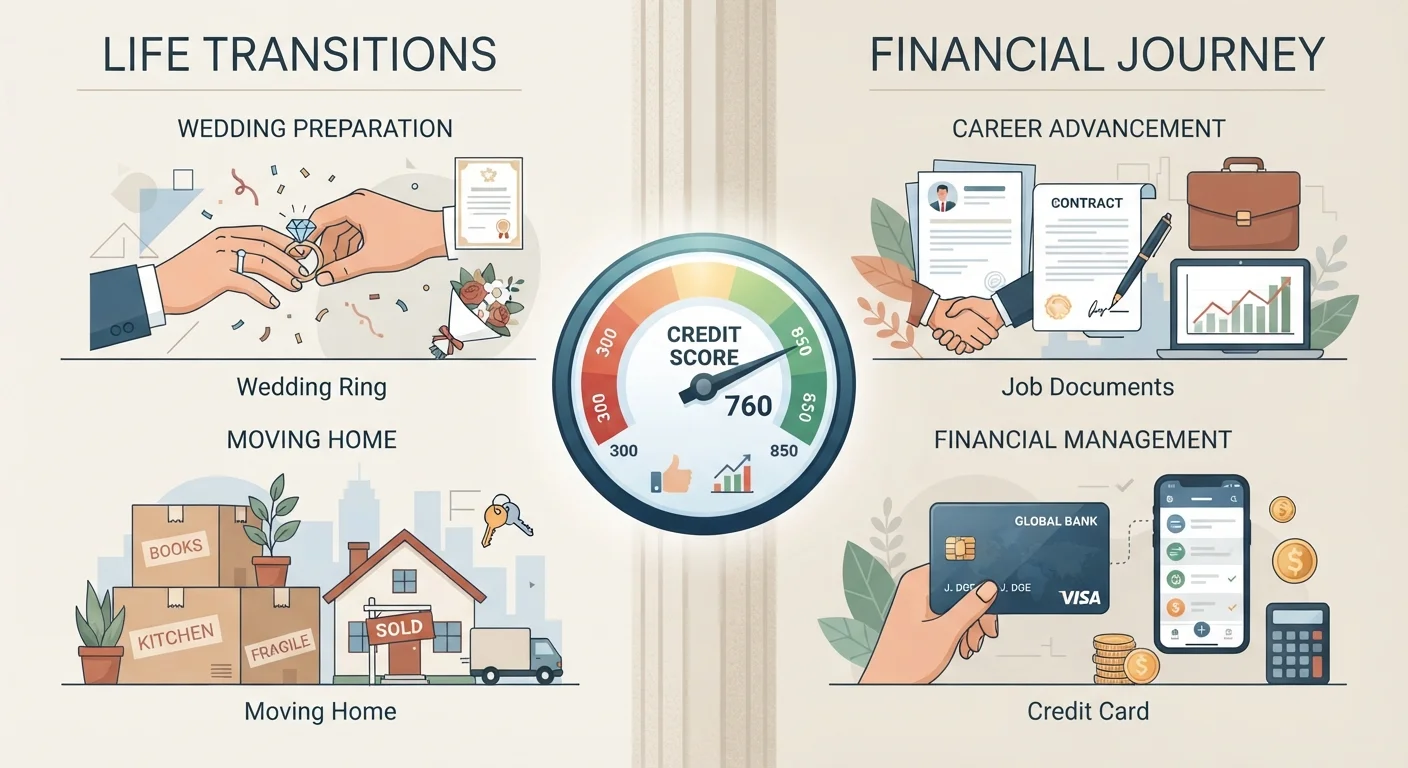
Photo: ScoutAnswers.com | Blogs That Ignite Curiosity editorial
Key Takeaways
- Marriage does not merge credit scores, but joint accounts and co-signed loans create shared credit responsibility.
- Divorce requires actively removing your name from joint debts - a court decree alone does not update creditors.
- Job loss doesn't directly lower your score, but missed payments caused by income disruption will.
- Relocating across state lines or internationally can affect your credit history's visibility and account standing.
- Monitoring your credit report during any major life change helps you catch problems before they compound.
Why Life Changes and Credit Are Closely Linked
Your credit profile is a living record. Every major life event - a new marriage, a divorce, a layoff, or a cross-country move - can shift the accounts, balances, and payment history that make up that record. Understanding the connection between these transitions and your credit gives you a concrete advantage: you can prepare before problems arise rather than repair damage after the fact.
For a thorough grounding in how credit scores and reports are structured, see our comprehensive guide to how consumer credit works. This article builds on that foundation by focusing on what changes - and what you should do - when your life circumstances shift significantly.
“Credit is a tool. Like any tool, it works best when you understand it - and major life transitions are exactly the moments when that understanding matters most.”
— Consumer Financial Protection Bureau, U.S. federal consumer financial watchdog agency
Getting Married: Separate Scores, Shared Consequences
A common misconception is that marriage merges credit scores. It does not. Each spouse retains their own individual credit file, and the act of marrying has no direct effect on either person's score. However, the financial decisions couples make together can have lasting joint consequences.
When you open a joint credit card or co-sign a mortgage, both parties' credit histories are affected by how that account is managed. A missed payment on a joint account will appear on both credit reports. Conversely, a partner with a thin or damaged credit history can begin building a stronger record by being added as an authorized user on a well-managed account - though the account holder carries full legal responsibility for the balance.
Before combining finances, it is worth reviewing both credit reports openly. If one partner carries significant debt, that debt-to-income ratio will matter when you apply for a mortgage together. Our guide on mortgage readiness explains how lenders evaluate joint applications in detail.
Review both credit reports before making major joint financial commitments.
Keep individual credit accounts open and active even after marriage.
Contact lenders directly to remove your name from joint accounts after divorce.
Call your lender before missing a payment during a period of financial hardship.
Update your address with every creditor immediately when you move.
Divorce: Untangling Credit Is a Separate Legal Step
Divorce proceedings divide assets and assign debts, but credit bureaus are not parties to that agreement. If a divorce decree assigns your former spouse responsibility for a joint credit card, but your name remains on the account, you are still legally liable to the lender - and any missed payment will still damage your credit score.
The practical step is to either close joint accounts once balances are paid or refinance joint debts into one person's name. Get written confirmation from lenders when accounts are closed or transferred. After the process is complete, pull your credit report to verify that accounts you are no longer responsible for no longer show open balances tied to your name. Our field guide to reading your credit report can help you navigate what you're looking at.
Job Loss and Financial Hardship: Protecting Your Score Under Pressure
Unemployment itself is not reported to credit bureaus and has no direct effect on your credit score. What does affect your score is what happens next: if income disruption leads to missed minimum payments, those late or missed payments will be reported and can remain on your report for up to seven years.
If you anticipate difficulty making payments, contact lenders proactively. Many offer hardship programs, temporary forbearance, or modified payment plans - and these arrangements are often less damaging than a reported delinquency. Keeping utilization low on any revolving credit you maintain is also important during this period; our article on how credit utilization affects your score explains why this metric responds so quickly to balance changes.
35%
Weight of payment history in FICO score calculation
Payment history is the single largest factor in standard FICO credit scoring models, making missed payments the most impactful negative event during any period of financial hardship.
7 years
How long a late payment stays on your credit report
Under the Fair Credit Reporting Act, most negative items including late payments and collections can remain on a credit report for up to seven years from the date of first delinquency.
Relocation: What Moving Does (and Doesn't) Do to Your Credit
Moving within the United States generally has minimal direct impact on your credit score. Your credit history follows you because it is tied to your Social Security number, not your address. However, there are indirect risks worth managing.
When you relocate, paper statements or security alert notifications can be missed if your address is not updated promptly with all creditors. A missed bill because it was sent to an old address still counts as a missed payment. Update your mailing address with each lender and enroll in electronic statements to eliminate this risk. If you are planning to buy a home after relocating, be aware that lenders will look at employment stability - a recent job change alongside a new mortgage application adds complexity. Our step-by-step guide to getting mortgage-ready covers how lenders assess employment history.
For moves outside the United States, credit history typically does not transfer across borders. You may need to rebuild credit from scratch in your new country. If you return to the US later, your prior history should still be accessible.
This article provides general financial information and education. It is not personalized financial, legal, or credit advice. For guidance specific to your situation, consult a qualified financial adviser or credit counselor.
The content on this site is for informational purposes only and is not a substitute for professional advice. Always consult a qualified professional for guidance specific to your situation.