
Reading a Wireless Plan: A Field Guide to the Terms Carriers Use

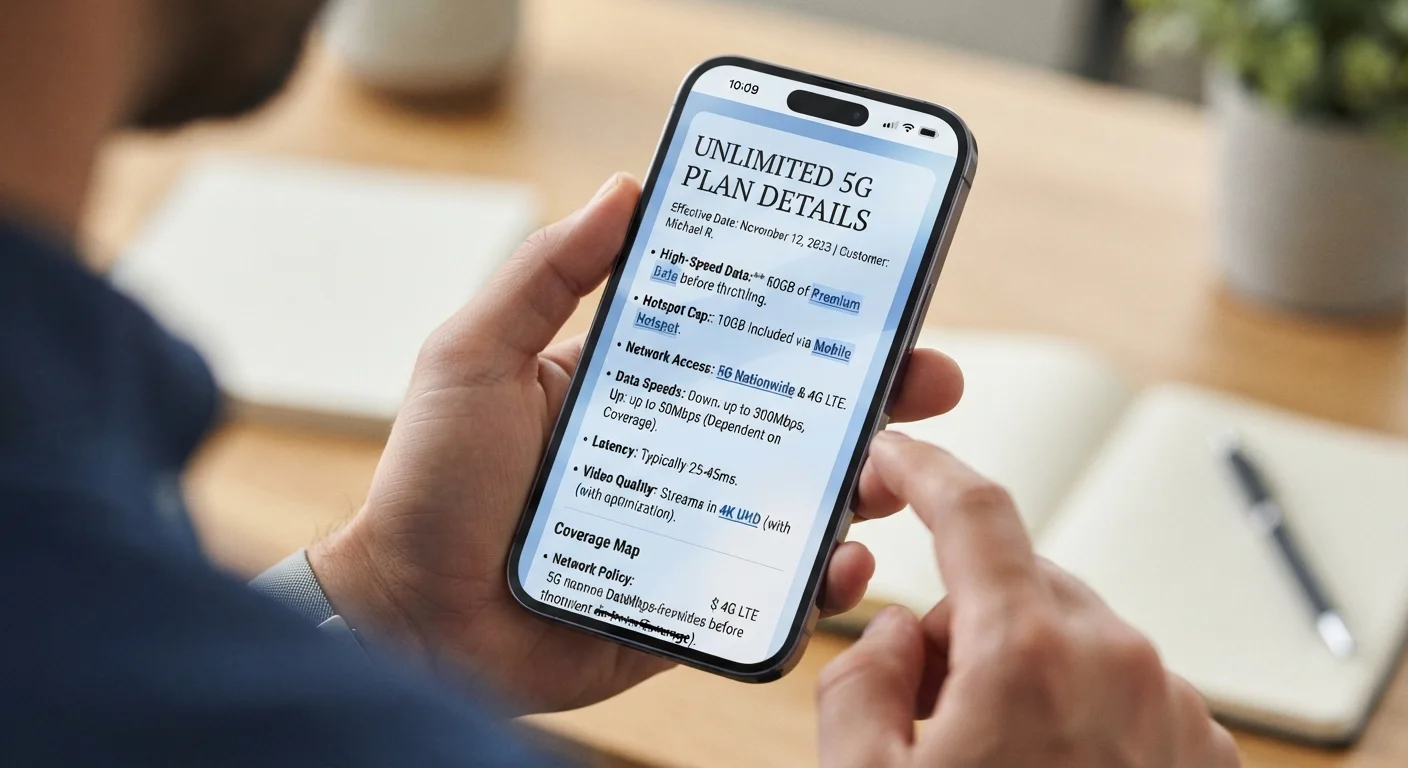
Photo: ScoutAnswers.com | Blogs That Ignite Curiosity editorial
Why Carrier Language Is Hard to Parse
Wireless plan descriptions pack a lot of meaning into a few words - and the words are often chosen to emphasize benefits while minimizing the visibility of limits. Terms like "unlimited," "premium data," and "nationwide coverage" appear on nearly every plan page, yet each carries conditions that only surface in the fine print. This reference defines the terms you're most likely to encounter so you can read any plan description with a clearer eye.
For a deeper look at how "unlimited" is routinely qualified, see our companion piece on unlimited plan fine print. And once you have the vocabulary, our carrier checklist walks you through the right questions to ask before committing.
| FCC disclosure label | Carriers are required to display Broadband Facts labels disclosing speeds, data limits, and network management practices (FCC Open Internet rules) |
| Typical deprioritization threshold | Commonly 22-100 GB of premium data depending on plan tier, after which deprioritization may apply (Carrier plan disclosures, varies by provider) |
| Hotspot allocation | Hotspot data is usually a subset of total data (e.g., 15-50 GB at full speed), not additional data (Standard carrier plan structures) |
| MVNO priority | MVNOs typically receive lower data priority than the host carrier's own postpaid subscribers during congestion (MVNO wholesale agreements, generally disclosed in terms) |
| Device unlock periods | Major carriers typically require 30-365 days of active service before unlocking a device, depending on policy (Individual carrier unlock policies) |
| Autopay discount conditions | Discounts may require a bank account debit rather than credit card to qualify, varying by carrier (Carrier plan terms) |
Core Data Terms Defined
These are the data-related terms most likely to appear in plan descriptions, promotional pages, and service agreements.
Premium data
A defined amount of high-speed data that the carrier guarantees will not be subject to deprioritization based on network congestion. Once exhausted, remaining data may still work but at lower effective speeds during busy periods.
Deprioritization
A network management practice where subscribers who have exceeded a data threshold are temporarily moved lower in the queue during congested periods. Speeds recover when congestion eases, distinguishing it from a hard speed cap.
Throttling
A hard reduction in data speed, often applied to specific services such as video streaming or to all traffic after a soft-cap threshold is reached. Unlike deprioritization, throttling is typically consistent regardless of network load.
Mobile hotspot
A feature that lets a phone share its cellular data connection with other devices over Wi-Fi. Plans frequently offer a separate - and lower - hotspot data allowance distinct from the general data bucket.
Network management
Broad carrier practices for optimizing traffic across a network. Disclosed in FCC-required Broadband Facts labels and may include deprioritization, video optimization, and application-specific speed adjustments.
MVNO
Mobile Virtual Network Operator - a wireless provider that resells access to a major carrier's network without owning towers. Pricing is often lower, but data priority may be secondary to the host network's direct subscribers.
Roaming
Using another carrier's network when outside your carrier's coverage area, often triggered in international travel or low-coverage domestic regions. Roaming rates and terms vary significantly by plan.
Postpaid vs. prepaid
Postpaid plans bill at the end of the month after usage, typically requiring a credit check. Prepaid plans are paid in advance, often require no credit check, and carry fewer contractual obligations.
Understanding how these terms interact matters in practice. A plan may advertise 50 GB of premium data, after which deprioritization applies - meaning your speeds could drop significantly during busy periods without the carrier technically violating any promise. Network management and throttling are related but distinct: management is typically conditional on congestion or data thresholds; throttling often refers to a hard speed cap applied to specific services (such as video streaming) regardless of network load.
Coverage language deserves its own scrutiny. "Nationwide" describes the geographic footprint of a network but says nothing about indoor reliability, rural depth, or building penetration. Our article on reading coverage maps explains where those maps tend to overstate reality.
Plan Structure and Billing Terms
Beyond data, plan language describes how billing, contracts, and device financing work. These terms are worth knowing before you sign anything.
- Autopay discount: A recurring monthly credit applied when you enroll in automatic payment from a bank account or qualifying card. The discount is typically $5-$10 per line but may be conditional on a specific payment method.
- Device payment agreement (DPA): A financing arrangement spread over 24 or 36 months. The device cost appears separate from your plan cost, though both appear on one bill. Early payoff or switching carriers may require settling the remaining balance.
- BYOD (Bring Your Own Device): Using a phone you already own rather than purchasing through the carrier. Savings depend on whether your device is unlocked and compatible with the carrier's network bands.
- SIM lock / unlock: Carriers may lock a device to their network for a period defined in their unlock policy. An unlocked phone can be used with any compatible carrier's SIM.
- Early termination fee (ETF): A fee charged for canceling a postpaid contract before its end date. ETFs have become less common as carriers shifted to device payment agreements, but the outstanding device balance serves a similar economic function.
- Proration: When a plan is started or canceled mid-cycle, charges are typically prorated - calculated as a fraction of the monthly rate for the days of service used.
If you're comparing wireless agreements to broadband contracts, the terminology overlaps more than you might expect. Our ISP contract guide covers the parallel concepts that appear in home internet agreements.
Check the Broadband Facts Label
Network and Technology Terms
Carriers increasingly use network generation labels (4G LTE, 5G Sub-6, 5G mmWave) as selling points. Understanding what these distinctions mean in everyday use helps calibrate expectations.
- LTE (Long-Term Evolution): The dominant 4G standard. Most U.S. users still rely on LTE for the majority of their connections, including indoors.
- 5G Sub-6: Mid-band and low-band 5G operating below 6 GHz. Offers modestly improved speeds and capacity over LTE across a wide geographic area.
- 5G mmWave: High-band 5G with very high throughput but limited range and poor building penetration. Largely confined to dense urban areas and specific venues.
- Band aggregation / Carrier aggregation: A technique that combines multiple frequency bands to increase throughput. A plan may not explicitly mention it, but it affects peak speeds your device can achieve.
- MVNO (Mobile Virtual Network Operator): A carrier that does not own its own towers but leases access from a major network operator. MVNOs often offer lower prices but may receive lower data priority than the host network's own subscribers.
For a fuller picture of what 5G actually delivers versus what marketing implies, see what 5G means for your plan. And to understand how carriers differ beyond their network technology, our analysis of U.S. carrier differences covers plan structure, coverage depth, and who each carrier tends to serve best.
The content on this site is for informational purposes only and is not a substitute for professional advice. Always consult a qualified professional for guidance specific to your situation.