
Cable vs. Fiber Internet: Sorting Out the Real Differences

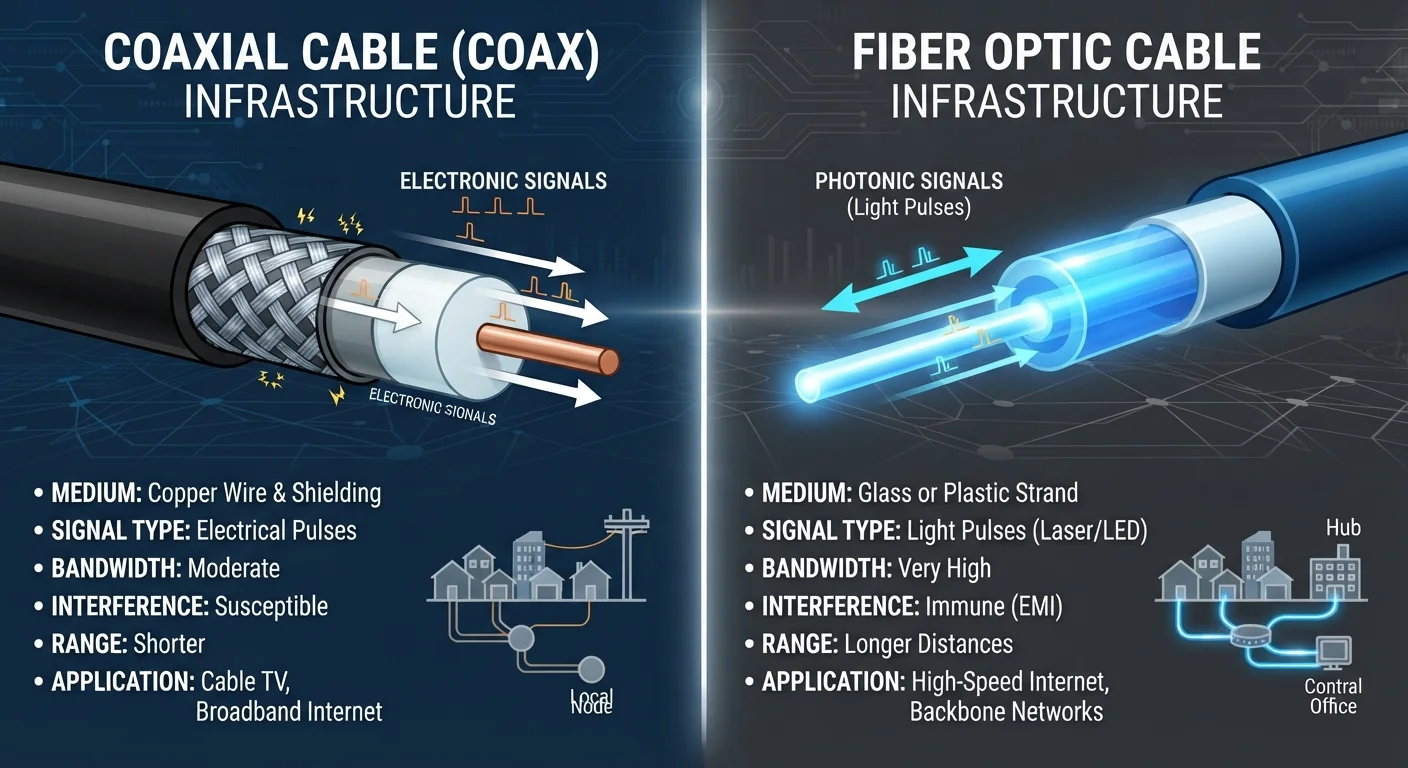
Photo: ScoutAnswers.com | Blogs That Ignite Curiosity editorial
Key Takeaways
- Cable uses existing coaxial infrastructure; fiber transmits data as light through glass or plastic strands.
- Fiber typically delivers symmetrical upload and download speeds; cable upload speeds are usually much slower than download speeds.
- Cable is available to roughly 88% of U.S. households; fiber availability remains significantly lower but is expanding.
- During peak hours, cable networks can slow noticeably due to shared bandwidth; fiber connections tend to be more consistent.
- Fiber installation often requires new physical infrastructure, which can delay or limit availability in some areas.
How Each Technology Works
Cable internet travels over the same coaxial copper-and-shielding lines that deliver cable television. Data is modulated onto radio frequency signals and shared across a neighborhood node before reaching individual homes. The shared-node model is key to understanding cable's main limitation: when many households in the same area are online simultaneously, available bandwidth is divided among them.
Fiber internet, by contrast, encodes data as pulses of light transmitted through thin glass or plastic strands. Because light signals don't degrade the way electrical signals do, fiber can carry far more data over longer distances with minimal signal loss. Each fiber subscriber typically connects to a dedicated strand rather than a shared node, which is why performance remains more stable under load.
For a broader look at how these technologies fit alongside DSL and fixed wireless, see our breakdown of the four main home internet technologies.
Speed and Symmetry: The Core Difference
Cable plans commonly advertise download speeds ranging from around 100 Mbps to over 1 Gbps. However, upload speeds on cable - which use a different, narrower channel on the coaxial line - typically top out well below download speeds, often in the 10-50 Mbps range on many plans. This asymmetry rarely matters for passive streaming but becomes a real friction point for video calls, remote desktop work, or uploading large files to cloud storage.
Fiber plans are typically symmetrical: a 500 Mbps fiber plan generally delivers 500 Mbps both downstream and upstream. This parity is built into the technology's design rather than a premium add-on.
| Criterion | Cable Internet | Fiber Internet |
|---|---|---|
| Transmission medium | Coaxial copper cable | Glass or plastic fiber strands |
| Typical download speeds | 100 Mbps - 1+ Gbps | 200 Mbps - 5+ Gbps |
| Typical upload speeds | 10-50 Mbps on many plans | Matches download (symmetrical) |
| Speed consistency at peak hours | Can slow due to shared nodes | Generally more stable |
| U.S. household availability | ~88% of addresses | Lower; expanding in metros |
| Infrastructure required | Existing coaxial network | New fiber build-out needed |
| Susceptibility to interference | Some electromagnetic interference risk | Immune to electromagnetic interference |
Before assuming you need a specific speed tier, it's worth understanding what those numbers actually translate to in everyday use. Our article on what internet speed numbers mean for your household breaks this down clearly.
Reliability and Congestion
Because cable nodes serve multiple households simultaneously, performance during evening peak hours - when most households are active - can dip noticeably. This isn't a flaw in cable per se; it's an inherent characteristic of shared-medium networks. Providers regularly upgrade node capacity to manage congestion, but the effect persists in denser areas.
Fiber's point-to-point or point-to-multipoint architecture is less vulnerable to this pattern. Congestion can still occur further upstream in a fiber provider's network, but the connection between the home and the nearest hub is generally not the bottleneck.
~88%
U.S. households with cable broadband access
According to FCC broadband deployment data, cable remains the most widely available fixed broadband technology by household coverage.
10x+
Typical fiber upload speed advantage over cable
Industry analyses consistently show fiber upload speeds outpacing comparable cable plan upload speeds by a significant multiple, depending on the tier.
43%
U.S. households with access to fiber broadband
FCC deployment reports indicate fiber availability has grown substantially but still covers less than half of U.S. addresses, with rural gaps remaining pronounced.
Both technologies are susceptible to weather-related outages at the infrastructure level, though fiber's signal is immune to the electromagnetic interference that can affect coaxial lines. If you want to verify how your current connection actually performs, see how to test and interpret your home internet speed.
Availability and Installation Realities
Cable's biggest practical advantage is reach. The existing coaxial infrastructure built for cable television extends across the vast majority of suburban and urban U.S. addresses, meaning providers can offer cable broadband without laying new lines in most cases.
Fiber requires purpose-built infrastructure. Providers must physically run new fiber strands - either aerially on utility poles or through underground conduit - to reach each building. This makes fiber rollouts capital-intensive and time-consuming. As a result, fiber availability, while growing steadily, remains lower than cable availability nationally, and tends to be concentrated in larger metros and newer residential developments.
For households in areas where neither cable nor fiber is available, the options are different altogether. Our guide to internet options for rural and remote addresses covers fixed wireless, satellite, and other alternatives. For a deeper look specifically at fiber's coverage limitations and installation process, see fiber internet's upsides, coverage gaps, and fine print.
Next-Generation Cable: DOCSIS 3.1 and Beyond
The content on this site is for informational purposes only and is not a substitute for professional advice. Always consult a qualified professional for guidance specific to your situation.